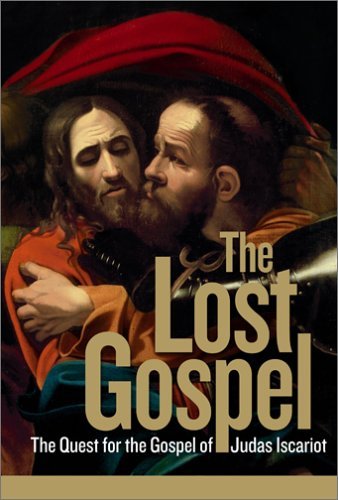
The National Geographic Channel has been pulling out all stops with its ad campaign for this Sunday's release of "The Gospel of Judas." For example . . .
SUNDAY, APRIL 9"The Gospel of Judas" at 8P et/ 7P ptThe Gospel of Judas is of one of the most important finds in biblical archaeology. Hidden for nearly 1,700 years, the document presents a new account of the life of Jesus. But can its authenticity be verified?
Source: http://channel.nationalgeographic.com/channel/ngcthisweek.html
Veteran religion writer Richard Ostling helps put the matter into perspective . . .
By RICHARD N. OSTLING AP Religion Writer
NEW YORK Mar 2, 2006 (AP)— An expert on ancient Egyptian texts is predicting that the "Gospel of Judas" a manuscript from early Christian times that's nearing release amid widespread interest from scholars will be a dud in terms of learning anything new about Judas.
James M. Robinson, America's leading expert on such ancient religious texts from Egypt, predicts in a new book that the text won't offer any insights into the disciple who betrayed Jesus. His reason: While it's old, it's not old enough.
"Does it go back to Judas? No," Robinson told The Associated Press on Thursday.
Source: http://abcnews.go.com/Technology/wireStory?id=1680974
Let's get this straight. A Basel foundation owns the manuscript. A Geneva scholar has been working to translate it. The owners "cut a deal" with the National Geographic Society to bring it to light with a television special. And, they select PALM SUNDAY night as the most appropriate time to air a "special" with a revisionistic view of Judas arguing that Judas Iscariot was carrying out God's will when he handed Jesus over to his executioners?
This copy of the "Gospel of Judas," possibly the same "gospel" referred to by Irenaeus (AD 180), dates from the third or fourth centuries. It probably comes from a Gnostic sect known for its heretical views, including the lauding of Cain, the Sodomites, and Judas. They regarded Judas as the "keeper of secret mysteries."
While the press treats such "revelations' as possible faith-shattering bombshells, the truth of the matter is far more prosaic. A Vatican historian called the claims being touted as mere "religious fantasy." Journalist Stacy Meichtry observed that the "manuscript could bring momentum to a broader academic movement that argues Judas has gotten a bum rap among historians and theologians as well as in popular culture."
James M. Robinson, editor of Nag Hammadi Gnostic texts, writes that the journey of the text to Switzerland was “replete with smugglers, black-market antiquities dealers, religious scholars, backstabbing partners and greedy entrepreneurs.'' Robinson fears that the text, agreed by all to be quite fragile and in poor shape, may have been mishandled and parts of it lost forever.
But even liberal critic Robinson speculates that the timing of the release is aimed at capitalizing on interest in the film version of “The Da Vinci Code'' -- a fictional tale that centers on a Christian conspiracy to cover up a marriage between Jesus and Mary Magdalene -- to be released in May and staring Tom Hanks.
Tuesday, April 04, 2006


Monday, April 03, 2006
A Textbook Case of "Post Fundamentalist Syndrome" or an Example of Intellectual Hubris and Leftward Drift?
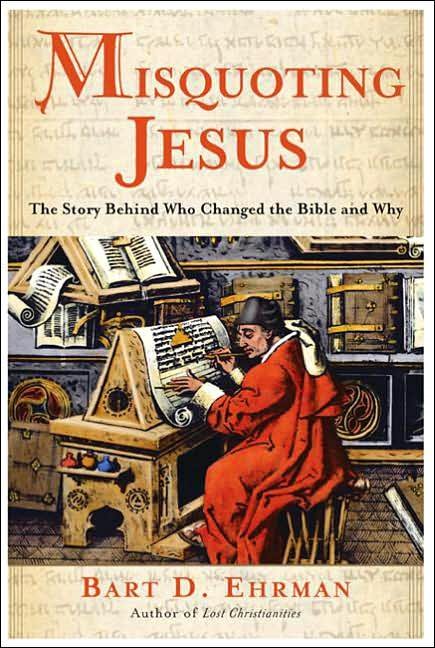
This past weekend I purchased Bart Ehrman’s Misquoting Jesus (Harper, 2005). Ehrman, Chair of the Department of Religious Studies at the UNC at Chapel Hill, first came to my attention as the professor extraordinaire who did the brilliant job of lecturing on New Testament history for the Teaching Company. The course was simultaneously engaging, enlightening, and infuriating.
Ehrman makes for an interesting study. A graduate of Moody Bible Institute and Wheaton College, he completed his academic credentials under the tutelage of venerable textual critic Bruce Metzger to whom the book is dedicated.
The key to understanding Ehrman’s purpose is found in the subtitle: “The story behind who changed the Bible and why.” Albert Mohler likes to say that Ehrman “has made rejecting the New Testament text a professional project.” His pilgrimage began spiritually in the evangelical certainty of Moody (where he recalls “we used to say Moody Bible Institute, where Bible is our middle name”) "ending up in a dead end" and finally taking him to a place of unashamed agnosticism.
How do we understand Ehrman and his journey? Is he just another “recovering fundamentalist” who has hyper-corrected to the opposite pole from unqualified certainty to completely qualified uncertainty? We all know our share of critics of Christianity who were formed in the cauldron of evangelicalism’s most toxic expressions. Does Bart Ehrman fit that mold?
Another interpretation would see Ehrman as a fairly typical example of what happens when hubris, unbridled human pride, runs amuck in the mind of a seemingly honest seeker after truth. The process of higher education often proves alienating. It can separate the scholar from the community that sent her or him off to “get an education.” It can also alienate the learner from the One who is the Truth. Paul explains it this way when dealing with the Corinthians and their prideful chasing after “knowledge”: “Knowledge makes arrogant, but love edifies” (1 Cor 8:1).
The sinful tendency to become enchanted listening to our own voices and our overly impressed by our own reason can easily lead even the most committed of us into the denial of truth and the embrace of palpable nonsense. Intellectual temptations are no less dangerous to the soul than bodily ones.
Having sent two of my five children to Moody to receive both their undergraduate and graduate educations, my heart aches to see what Dr. Ehrman has done with his. He possesses such gifts, such winsomeness, and such charisma in the classroom.
His story should serve as a severe reminder to all of us to beware lest we fall. The gift of scholarship was never meant to be separated from the life of prayer and piety. The temptation to follow the world in the field of knowledge, no less than the lure of following the world in the areas of sex or money, can only be resisted in the strength of the Lord, through the ministry of the Spirit, because of the finished sacrificial work of Christ for us.
Ehrman makes for an interesting study. A graduate of Moody Bible Institute and Wheaton College, he completed his academic credentials under the tutelage of venerable textual critic Bruce Metzger to whom the book is dedicated.
The key to understanding Ehrman’s purpose is found in the subtitle: “The story behind who changed the Bible and why.” Albert Mohler likes to say that Ehrman “has made rejecting the New Testament text a professional project.” His pilgrimage began spiritually in the evangelical certainty of Moody (where he recalls “we used to say Moody Bible Institute, where Bible is our middle name”) "ending up in a dead end" and finally taking him to a place of unashamed agnosticism.
How do we understand Ehrman and his journey? Is he just another “recovering fundamentalist” who has hyper-corrected to the opposite pole from unqualified certainty to completely qualified uncertainty? We all know our share of critics of Christianity who were formed in the cauldron of evangelicalism’s most toxic expressions. Does Bart Ehrman fit that mold?
Another interpretation would see Ehrman as a fairly typical example of what happens when hubris, unbridled human pride, runs amuck in the mind of a seemingly honest seeker after truth. The process of higher education often proves alienating. It can separate the scholar from the community that sent her or him off to “get an education.” It can also alienate the learner from the One who is the Truth. Paul explains it this way when dealing with the Corinthians and their prideful chasing after “knowledge”: “Knowledge makes arrogant, but love edifies” (1 Cor 8:1).
The sinful tendency to become enchanted listening to our own voices and our overly impressed by our own reason can easily lead even the most committed of us into the denial of truth and the embrace of palpable nonsense. Intellectual temptations are no less dangerous to the soul than bodily ones.
Having sent two of my five children to Moody to receive both their undergraduate and graduate educations, my heart aches to see what Dr. Ehrman has done with his. He possesses such gifts, such winsomeness, and such charisma in the classroom.
His story should serve as a severe reminder to all of us to beware lest we fall. The gift of scholarship was never meant to be separated from the life of prayer and piety. The temptation to follow the world in the field of knowledge, no less than the lure of following the world in the areas of sex or money, can only be resisted in the strength of the Lord, through the ministry of the Spirit, because of the finished sacrificial work of Christ for us.
Barna Annual Survey Finds Five Positive Trends in 2006 Evangelical Belief and Behavior
Pollster George Barna, evangelicalism’s very own version of an Old Testament prophet, who so often brings tidings of bad news and worse, released word of several positive trends in his April 3, 2006 report.
According to the work of the Barna Group, based upon new data from their annual tracking survey of religious behavior and beliefs, “there has been a significant increase in religious activity related to five of the seven core religious behaviors studied by the company.”
In the words of the Barna group:
“The most prolific jump in activity relates to Bible reading. Bible readership plummeted to a 20-year low of just 31% in 1995, and began to slowly climb back to higher levels, finally returning to the 40% mark in 2000. After several years of stalled growth, increases began again in 2004, continuing through 2006, when Bible readership hit 47% of adults reading the Book during a typical week, other than when they are at church. That is the highest readership level achieved since the 1980s, according to the Barna tracking data.”
Among the other positive signs cited by the Barna Group: Church attendance has rebounded to 47% from the 37% recorded in 1991; small group participation has reached a new high in 2006 with 23% engaged in such a gathering during a typical week; church volunteerism has finally returned to its 1991 high of 27%; even adult Sunday school attendance has climbed from its 17% mark in 1996 to 24%.
Only prayer and evangelism showed no signs of significant change among the persons polled who met the Barna criteria as evangelicals: "Survey respondents who were born again Christians – meaning they had made a commitment to Christ that was important in their life, and believed they would go to Heaven after they died solely because they had confessed their sins and accepted Christ as their savior."
Source: http://www.barna.org/FlexPage.aspx?Page=BarnaUpdateNarrowPreview&BarnaUpdateID=232.
According to the work of the Barna Group, based upon new data from their annual tracking survey of religious behavior and beliefs, “there has been a significant increase in religious activity related to five of the seven core religious behaviors studied by the company.”
In the words of the Barna group:
“The most prolific jump in activity relates to Bible reading. Bible readership plummeted to a 20-year low of just 31% in 1995, and began to slowly climb back to higher levels, finally returning to the 40% mark in 2000. After several years of stalled growth, increases began again in 2004, continuing through 2006, when Bible readership hit 47% of adults reading the Book during a typical week, other than when they are at church. That is the highest readership level achieved since the 1980s, according to the Barna tracking data.”
Among the other positive signs cited by the Barna Group: Church attendance has rebounded to 47% from the 37% recorded in 1991; small group participation has reached a new high in 2006 with 23% engaged in such a gathering during a typical week; church volunteerism has finally returned to its 1991 high of 27%; even adult Sunday school attendance has climbed from its 17% mark in 1996 to 24%.
Only prayer and evangelism showed no signs of significant change among the persons polled who met the Barna criteria as evangelicals: "Survey respondents who were born again Christians – meaning they had made a commitment to Christ that was important in their life, and believed they would go to Heaven after they died solely because they had confessed their sins and accepted Christ as their savior."
Source: http://www.barna.org/FlexPage.aspx?Page=BarnaUpdateNarrowPreview&BarnaUpdateID=232.
Friday, March 31, 2006
Bringing the Words of the Wise to Your Computer in the Nick of Time - When Unity Becomes More Conspiracy Than Communion
A good friend took the time to assemble an amazing collection of quotes. Their application to the current ABC crisis requires no commentary or interpretation.
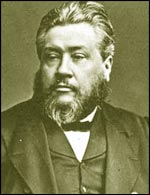
What Is Christian Unity: Unity with Truth or Unity at the expense of Truth? "Constantly we hear of proposals for unity and union . . . but what is the use of pretending where there can be none? There is another matter which needs to be thought of as well as unity and union, and that is TRUTH. To part with truth to show charity is to betray our Lord with a kiss. Between those who believe in the eternal verities and those who constantly cast doubt on them there can be no unity or union." C. H. Spurgeon, The Sword and Trowel (February, 1887), page 91.
"On all hands we hear cries for unity in this and unity in that; but to our mind the main need of this age is not compromise but conscientiousness. 'First pure, then peaceable' (James 3:17). It is easy to cry 'A confederacy', but that union which is not based on the truth of God is rather a conspiracy than a communion. Charity by all means; but honesty also. Love, of course, but love to God as well as love to men, and love of truth as well as love of union. It is exceedingly difficult in these times to preserve one's fidelity before God and one's faternity among men. Should not the former be preferred to the latter if both cannot be maintained? We think so." C. H. Spurgeon, The Sword and Trowel (April, 1887), page 196.
"To pursue union at the expense of truth is treason to the Lord Jesus Christ." C. H. Spurgeon, The Sword and Trowel (November, 1887), page 558.
"It is clear to everyone who is willing to see it that laxity of doctrine is either the parent of worldliness, or is in some other way very near akin to it. The men who give up the old faith are the same persons who plead for latitude as to general conduct. Liberal ministers gain a certain popularity by pandering to prevailing tastes." C. H. Spurgeon, The Sword and Trowel (December, 1887), page 606.
"The bare faced manner in which certain persons assert that 'to separate from men who hold vital errors is contrary to the mind of Christ' would be amusing if it were not saddening. They write as if such a Book as the New Testament were not in existence; they evidently decide what the mind of Christ ought to be without referring to such poor creatures as the Apostles. As for myself, I think more of Paul and John than of the whole body of modern thinkers. What saith the Scriptures? Read Galatians 1:6-10 and 2 John 9-11 for yourselves. The spirit of Scripture is one, and therefore we may be sure that decision for truth and separation from the erring are in full consistency with the charity of 1 Corinthians 13. It is true charity to those who err to refuse to aid and abet them in their errors." C. H. Spurgeon, The Sword and Trowel (December, 1887), page 642.
"To remain in doctrinally mixed denominations is contrary to Scriptural principles because thereby: (1) the specific commands for separation in such situations are disobeyed and (2) the Gospel is compromised, if not denied, since such is an attempt at union is only achieved at the expense of vital Christian truth and (3) real union is hindered. For ourselves we cannot be associated in any way with a movement which implies that the evangelical faith is but one of many equally valid insights and traditions. We believe evangelical churches ought to be seen in fellowship with each other and not with those who reject the authority of Scripture and the complete work of Christ." British Evangelical Council, BEC Attitude Toward Ecumenical Union (London, 1968), page 1.
[His Barking Dog may have the tenacity of the proverbial junk yard dog. However, the barking only happens when danger appears near home. The opinions here have nothing to do with officials or leaders in the PSW]
What Is Christian Unity: Unity with Truth or Unity at the expense of Truth? "Constantly we hear of proposals for unity and union . . . but what is the use of pretending where there can be none? There is another matter which needs to be thought of as well as unity and union, and that is TRUTH. To part with truth to show charity is to betray our Lord with a kiss. Between those who believe in the eternal verities and those who constantly cast doubt on them there can be no unity or union." C. H. Spurgeon, The Sword and Trowel (February, 1887), page 91.
"On all hands we hear cries for unity in this and unity in that; but to our mind the main need of this age is not compromise but conscientiousness. 'First pure, then peaceable' (James 3:17). It is easy to cry 'A confederacy', but that union which is not based on the truth of God is rather a conspiracy than a communion. Charity by all means; but honesty also. Love, of course, but love to God as well as love to men, and love of truth as well as love of union. It is exceedingly difficult in these times to preserve one's fidelity before God and one's faternity among men. Should not the former be preferred to the latter if both cannot be maintained? We think so." C. H. Spurgeon, The Sword and Trowel (April, 1887), page 196.
"To pursue union at the expense of truth is treason to the Lord Jesus Christ." C. H. Spurgeon, The Sword and Trowel (November, 1887), page 558.
"It is clear to everyone who is willing to see it that laxity of doctrine is either the parent of worldliness, or is in some other way very near akin to it. The men who give up the old faith are the same persons who plead for latitude as to general conduct. Liberal ministers gain a certain popularity by pandering to prevailing tastes." C. H. Spurgeon, The Sword and Trowel (December, 1887), page 606.
"The bare faced manner in which certain persons assert that 'to separate from men who hold vital errors is contrary to the mind of Christ' would be amusing if it were not saddening. They write as if such a Book as the New Testament were not in existence; they evidently decide what the mind of Christ ought to be without referring to such poor creatures as the Apostles. As for myself, I think more of Paul and John than of the whole body of modern thinkers. What saith the Scriptures? Read Galatians 1:6-10 and 2 John 9-11 for yourselves. The spirit of Scripture is one, and therefore we may be sure that decision for truth and separation from the erring are in full consistency with the charity of 1 Corinthians 13. It is true charity to those who err to refuse to aid and abet them in their errors." C. H. Spurgeon, The Sword and Trowel (December, 1887), page 642.
"To remain in doctrinally mixed denominations is contrary to Scriptural principles because thereby: (1) the specific commands for separation in such situations are disobeyed and (2) the Gospel is compromised, if not denied, since such is an attempt at union is only achieved at the expense of vital Christian truth and (3) real union is hindered. For ourselves we cannot be associated in any way with a movement which implies that the evangelical faith is but one of many equally valid insights and traditions. We believe evangelical churches ought to be seen in fellowship with each other and not with those who reject the authority of Scripture and the complete work of Christ." British Evangelical Council, BEC Attitude Toward Ecumenical Union (London, 1968), page 1.
[His Barking Dog may have the tenacity of the proverbial junk yard dog. However, the barking only happens when danger appears near home. The opinions here have nothing to do with officials or leaders in the PSW]
Thursday, March 30, 2006
2006 Yearbook of American & Canadian Churches Records Declines by All Mainline Denominations; ABCUSA Drops Smallest Percentage of the Mainlines
New York, March 30, 2006 -- According to NCC communications officer, Phil Jenks, "The National Council of Churches' 2006 Yearbook of American and Canadian Churches, one of the nation's oldest and most reliable sources of church membership and growth trends, is reporting this month on a record 219 national church bodies."
"The Rev. Dr. Eileen W. Lindner, editor of the 89-year-old annual since 1998, said the number of national church bodies 'is reflective of a remarkably robust immigration history and the cultural and constitutional freedom of religion so characteristic of the United States,'" Jenks writes. Lindner is the NCC's Deputy General Secretary for Research and Planning.
Despite mainline losses, Linder's report records continuing growth in a number of non-mainline churches. Among the largest 25 churches in the U.S., the fastest growing are the Assemblies of God (increasing 1.81 percent to 2,779,095), the Church of Jesus Christ of Latter Day Saints (increasing 1.74 percent to 5,999,177) and the Roman Catholic Church (increasing .83 percent to 67,820,833).
Six of the mainline denominations, including the ABCUSA, rank in the top 25 denominations in the U.S. as follows:
#3. The United Methodist Church, 8,186,254 members, reporting a decrease of .79%.
#7. Evangelical Lutheran Church in America, 4,930,429, reporting a decrease of 1.09%.
#9. Presbyterian Church (USA), 3,189,573 members, reporting a decrease of 1.60%.
#15. Episcopal Church, 2,463,747, reporting a decrease of 1.55%.
#20. American Baptist Churches in the USA, 1,432,840, reporting a decrease of .57%.
#21. United Church of Christ, 1,265,786, reporting a decrease of 2.38%.
The ABCUSA decline of .57% was the smallest decrease of the mainline denominations. The UCC registered the steepest drop with 2.38%. Of the mainline church bodies, the ABC has the reputation as having the most conservative theological stance; the UCC with its endorsement of same-sex marriage, represents the most progressive.
Following the nearly 3.5% slide reported in a prior yearbook, such results can hardly cheer the hearts of ABC leadership. While it may be true that we are not dying as rapidly as our fellow mainline sisters, the trend line points to the same terminal end point. Or, as Glenn Layne would put it: " The ABC is the slowest sinking ship among the mainlines."
Source: "NCC News" Thu, Mar 30, 2006. http://www.ncccusa.org/news/060330yearbook1.html
"The Rev. Dr. Eileen W. Lindner, editor of the 89-year-old annual since 1998, said the number of national church bodies 'is reflective of a remarkably robust immigration history and the cultural and constitutional freedom of religion so characteristic of the United States,'" Jenks writes. Lindner is the NCC's Deputy General Secretary for Research and Planning.
Despite mainline losses, Linder's report records continuing growth in a number of non-mainline churches. Among the largest 25 churches in the U.S., the fastest growing are the Assemblies of God (increasing 1.81 percent to 2,779,095), the Church of Jesus Christ of Latter Day Saints (increasing 1.74 percent to 5,999,177) and the Roman Catholic Church (increasing .83 percent to 67,820,833).
Six of the mainline denominations, including the ABCUSA, rank in the top 25 denominations in the U.S. as follows:
#3. The United Methodist Church, 8,186,254 members, reporting a decrease of .79%.
#7. Evangelical Lutheran Church in America, 4,930,429, reporting a decrease of 1.09%.
#9. Presbyterian Church (USA), 3,189,573 members, reporting a decrease of 1.60%.
#15. Episcopal Church, 2,463,747, reporting a decrease of 1.55%.
#20. American Baptist Churches in the USA, 1,432,840, reporting a decrease of .57%.
#21. United Church of Christ, 1,265,786, reporting a decrease of 2.38%.
The ABCUSA decline of .57% was the smallest decrease of the mainline denominations. The UCC registered the steepest drop with 2.38%. Of the mainline church bodies, the ABC has the reputation as having the most conservative theological stance; the UCC with its endorsement of same-sex marriage, represents the most progressive.
Following the nearly 3.5% slide reported in a prior yearbook, such results can hardly cheer the hearts of ABC leadership. While it may be true that we are not dying as rapidly as our fellow mainline sisters, the trend line points to the same terminal end point. Or, as Glenn Layne would put it: " The ABC is the slowest sinking ship among the mainlines."
Source: "NCC News" Thu, Mar 30, 2006. http://www.ncccusa.org/news/060330yearbook1.html
Free Training Materials on Leadership, Management, Spiritual Assessment, and Ministry to Homosexuals
In addition to items for purchase, Christianity Today's "Building Church Leaders" website has a variety of free training materials, including Powerpoint presentation, articles, cartoons, etc. -- all for quick download. The training resources are ideal for in-servicing your board or special educational sessions.
Here is what they offer free . . .
* Cartoon Pack Sample
* Creating Community Training Theme
* The DNA of Relationships Powerpoint
* Motivating Leaders Powerpoint
* Spiritual Growth Assessment Pack
* Influence Those Above You - Children's Ministry
* Reacing Out to Homosexuals - Survival Guide
http://store.yahoo.com/buildingchurchleaders/freesamples.html
Here is what they offer free . . .
* Cartoon Pack Sample
* Creating Community Training Theme
* The DNA of Relationships Powerpoint
* Motivating Leaders Powerpoint
* Spiritual Growth Assessment Pack
* Influence Those Above You - Children's Ministry
* Reacing Out to Homosexuals - Survival Guide
http://store.yahoo.com/buildingchurchleaders/freesamples.html
Northern's Moore Resigns to Pastor a C&MA Church Near Dayton, Ohio
At the March 2, 2006 meeting, the Northern Seminary Board of Trustees received and accepted the resignation of President Charles W. Moore, which will take effect June 5. Moore was Northern Seminary’s ninth President and the first Northern alumnus (D.Min.’93) to serve in that office. During the June Commencement celebrations, the Board will host an event to honor Moore for his years of service and ministry at the Seminary.
Moore's five year tenure was marked by an increase in enrollment and an expansion of the donor base. He will be remembered for his commitment to spiritual formation and the pastoral preparation of students.
The press release from the seminary offered the following words from the President.
“I have appreciated the opportunity to serve God at Northern for the past five years,” said Moore. “Having served a vibrant and growing evangelical congregation before coming to Northern, the possibility of returning to pastoral ministry was inviting. It has been a joy to be used by God in the preparation of students for ministry. I look forward to Northern Seminary’s continued growth and success!”
Moore's presidency encouraged conservatives who saw him as an ideological ally dedicated to continuing the direction of his predecessor, Ian Chapman. At the same time these very qualities proved frustrating to some progressives. While he was a member of the General Board of the American Baptist Churches USA, he also served on the Executive Committee of the American Baptist Evangelicals. Some older alums and donors took exception to his outspoken advocacy for evangelicalism and his willingness to host the ABE "Summit to Lead" conference last fall on the Northern campus. Moore also met some resistance because he was willing to confront faculty members and challenge them to find their place within the broad parameters of the seminary's evangelical theological position.
Moore leaves Northern to assume the pastorate of a large congregation near Dayton, Ohio, affiliated with the Christian and Missionary Alliance.
Moore's five year tenure was marked by an increase in enrollment and an expansion of the donor base. He will be remembered for his commitment to spiritual formation and the pastoral preparation of students.
The press release from the seminary offered the following words from the President.
“I have appreciated the opportunity to serve God at Northern for the past five years,” said Moore. “Having served a vibrant and growing evangelical congregation before coming to Northern, the possibility of returning to pastoral ministry was inviting. It has been a joy to be used by God in the preparation of students for ministry. I look forward to Northern Seminary’s continued growth and success!”
Moore's presidency encouraged conservatives who saw him as an ideological ally dedicated to continuing the direction of his predecessor, Ian Chapman. At the same time these very qualities proved frustrating to some progressives. While he was a member of the General Board of the American Baptist Churches USA, he also served on the Executive Committee of the American Baptist Evangelicals. Some older alums and donors took exception to his outspoken advocacy for evangelicalism and his willingness to host the ABE "Summit to Lead" conference last fall on the Northern campus. Moore also met some resistance because he was willing to confront faculty members and challenge them to find their place within the broad parameters of the seminary's evangelical theological position.
Moore leaves Northern to assume the pastorate of a large congregation near Dayton, Ohio, affiliated with the Christian and Missionary Alliance.
Tuesday, March 28, 2006
Breaking News: Historic Mega Chruch Pomona First Baptist Votes UNANIMOUSLY to Support Withdrawal from ABC - "What else could we do?"
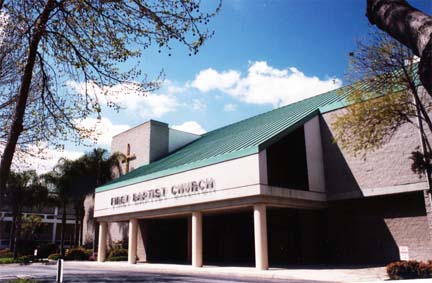 Pomona First Baptist, PSW mega church with a 135 year history of strong mission support for the ABC, voted unanimously tonight to support the recommended PSW withdrawal from the ABCUSA. In a special business meeting called to deal with the upcoming April 29 vote of PSW representatives, members of the flagship church received a presentation from Dr. Glenn K. Gunderson, considered the issue, spoke openly of their frustrations with denominational direction, and cast their unanimous vote on the side of separation.
“The evening was amazing,” reported Dale Torry, former missions’ pastor of the congregation and a current member. “Our congregation spoke about wanting to set an example for the rest of the region and denomination,” Torry said. “Several people mentioned that this was our time to take a leadership role for others who might be in more conflicted situations.”
During much of its history, First Baptist has been a leading congregation in both the PSW region and the ABCUSA as a whole. With a record of strong mission support, the church where approximately 3,000 people worship on an average weekend, has frequently led the denomination in several categories of mission giving through the years. Gunderson, a leading American Baptist pastor who served in upstate New York and Southern California, was part of the Seek It! committee that crafted the current ABCUSA vision statement.
Should the region follow through with an actual separation from the ABCUSA, church members were told that a vote for the congregation to withdraw would likely take place later in the year.
[This time His Barking Dog only reports; you decide]
But . . . he is my friend!
 He is my friend. Of all the good women and men I have met in denominational work outside my own region, he has always been my favorite. Spending hours and days in denominational meetings for nearly six years taught me to respect his keen intellect, appreciate his gracious demeanor, prize his deep wisdom, admire his evident concern for spirituality, and love this man. Quite simply, he was the best servant leader I have ever known in the ABCUSA!
As a pastor, few could match him. As a denominational official he was refreshingly straight forward, willing to listen to those outside his circle, and always quick to propose the very best solutions for any problem we faced. And, he has been incredibly gracious to me, even nominating me for an important denominational position and taking heat from the then General Secretary for doing it. While we usually disagreed on most issues, our long talks and walks discussing the impending division in the ABC were among my very best moments in denominational work. I am firmly convinced that if he had remained in service at Valley Forge a little longer, this current ABC crisis might be happily behind us.
So receiving an invitation to his wedding should have filled me with joy and excitement. Instead, it was a textbook study in the deep and painful angst of cognitive dissonance. Psychologists since Festinger have explained it thusly:
“Cognitive dissonance is a psychological phenomenon which refers to the discomfort felt at a discrepancy between what you already know or believe, and new information or interpretation. It therefore occurs when there is a need to accommodate new ideas, and it may be necessary for it to develop so that we become ‘open’ to them.”
Put simply, that means that when you hold a value or belief that stands in shocking variance to what you learn about another value, belief, or person, you are put into existential discomfort.
For, you see, the invitation announced that my friend was marrying his long time companion and partner in a same sex union. This was not a surprise. Ten years ago, after serving spectacularly in an important denominational assignment, he telephoned me. I was being honored, he said, as one of only a handful of colleagues receiving advance notice that he was resigning his position to return to the pastorate. That was the “text,” I said, “what is the subtext?” He informed me of what I had long suspected. My friend had been living in a covenantal relationship with another man for several years and wanted to come “out of the closet.”
Now a decade later, and in a state which accommodates such unions, my ABC pastor friend is preparing to enter into holy vows in a Service of Marriage. Part of me wants to shout my excitement for this important step in his life. We all want our friends to live happy and fulfilled lives. The amazing tenacity of this union, more than fifteen years and counting, surely testifies to something of the character of my friend. And, the congregation he leads, a welcoming and affirming one, can be counted upon to celebrate joyfully this upcoming union of two of their own members.
But, my heart breaks because such feelings of joy are drowned out by other emotions and disquieting thoughts that will not let me go. As much as my heart wants to reach out to my friend and esteemed colleague, my mind keeps remembering my own ordination vows, promises made nearly three decades ago to proclaim the changeless Word of God and to defend it faithfully.
No matter how hard I try—and believe me with so many friends on the other side of the aisle on this issue, I have tried—to adjust my hermeneutic to include my friend’s practice, I have been unable to find a way to do it. All of the books, as early as Scanzoni and Mollenkott, through Boswell, and up to current writings in New Testament and “reader response” hermeneutics, fail to persuade me. God’s redemptive Word speaks forth powerful words of welcome. We did not seek him, but he sought us and sent his Son to us. But it does not stop with his “welcome.”
When John wrote that “God sent his only Son into the world” (1 John 4:9. 10), he spoke of a permanent mission to us expressing an awesome welcome conjoined with the “deeper magic” of redemptive transformation. The sending and the giving involved a power able to erase our guilt, assuage God’s holy wrath, and to transform the sinner. As Bloesch has written, “It is God who in the person of His Son swallows up evil within Himself through vicarious identification with the sin of His people. A sacrifice was necessary to satisfy the demands of His law, but God Himself provided the Sacrifice out of His incomparable love.”
Our message of redemption is not merely one of dealing transactionally with our guilt but God transformationally creating a new man. Despite our very existential struggles to live out the meaning of this new humanity, the Gospel simply does not give us rights to revise the Word of God to fit the various psychological phenomena we confront in this fallen world. Indeed, if we allow ourselves to compromise and to adjust the Word of God, we run the risk of altering the Gospel and depriving it of its transformational power.
Ironically, if my friend had remained in denominational service, I do not believe we would be in the current political crisis in the ABC. More than a decade ago he and the then PSW executive minister had devoted a good bit of time to exploring the contours of an amicable divorce in the ABCUSA. Recognizing that our hermeneutics simply would not allow for a successful synthesis on the issue of same sex unions (particularly ordination of practicing homosexuals), both my friend and Dr. John Jackson talked lengthily about ways to engineer a division devoid of rancor and ugly recriminations. Had their conversation continued just a bit longer, we might be happily beyond the current impasse, pursuing God’s call as we see it in two organizations.
If differing convictions about baptism or church polity are sufficient reason to bless one another and follow our sense of God’s call in separate denominations (e.g., Baptists, Presbyterians, Methodists), why should we balk at an amicable parting over such a fundamental issue as human sexuality? We do not deny the authenticity of the faith of our sisters and brothers who believe differently from us. We merely insist that some issues are not worth diverting our attention from crucial issues of mission to argue and wrangle endlessly. This one, unlike abortion, women in ministry, divorce and remarriage, and other controversies of the last decades goes to the root of our understanding of the Gospel and the Word of God. Our differences, sadly, are profound and intractable.
So, where does that leave me and my friend? I do not know. When he informed me of his decision a decade ago, we joked that if he were in the PSW, as chair of the Ordination Standards Committee I would be responsible to initiate proceedings against him for misconduct. Yet, my heart goes out to him. He has not ceased being that amazing man of wisdom, vision, compassion, and intellect I know. May the Lord bless him richly and deeply until we meet again.
[His Barking Dog professes no official position or right to speak for the PSW. I am about as much an official spokesperson for the PSW as Senator Feingold is for President Bush.]
Sunday, March 26, 2006
What About Dr. Roberts' Reasons for Staying in the ABCUSA? Giving His Ten Points a Closer Look
Dr. Bob Roberts is a great guy and a wonderful communicator. We have traded prayer requests and swapped stories. His ministry and stewardship materials have both blessed and challenged me. He has even used a dramatic incident in one of my children's lives as a powerful aid for his own sermonizing. But, in this dispute, we stand on opposite sides of the issue. The following ten points come from Bob's "Ten Reasons Why I Would Not Leave the American Baptist Churches USA" (edited for greater clarity). His reasons are bolded, mine follow in regular type.
1. A variety of evidences of God's blessing on the ABCUSA.
Roberts claiming that the ABC is the "fastest growing mainline denomination" is deceptive at best. Steep declines among the other six mainline denominations since 1960 have been a staple of religious commentary and sociological analysis. A news release last spring from the National Council of Churches (and authored by former ABC magazine editor Phil Jenks) reported that the ABC lost 3.45% in 2004.
One might suggest that ABC statistics are better than the other six mainline denominations in part because we are probably more evangelical than bodies like the UMC or UCC. Beyond that, the ABC counts dual alignments of congregations which come from among some large and healthy growing African-American churches. Yet even numbering congregations that participate in ABC life in minimal ways cannot erase the deficits. The 3.45% decline in the most recently reported year does not bode well for the future. Many more years with such declining numbers would "grow" us into oblivion.
Roberts' suggestion that we have a "cutting edge global ministry" masks the fact that our missionary force represents an anemic 1 missionary for every 12,000 members. In a few decades we have gone from hundreds of missionaries on the field to around 120.
Similarly, citing 2005 as a banner year in mission giving does not mention the influx of Tsunami and Katrina relief funds that swelled the totals. Nor does it tell about a decline in UM support so significant that the Executive Committee minutes from November sounded a warning that the lack of support for the Office of the General Secretary cannot be sustained beyond 2006. And, in this month's meeting of the General Board Executive Committee a proposal was endorsed to eliminate 50% of the General Board meetings as one way to deal with some of the shortfall.
Finally, holding up "thousands of testimonies" from the Seek It! hardly stands up to scrutiny. Use of the Appreciative Inquiry process forced respondents to offer only positive input and screened out negative feedback by design.
2. Confusion regarding continuing ABCPSW relationships (i.e., the problem of "schism a la carte").
Roberts predicts that "picking and choosing" rather than following the pattern where "most churches that have left the Region or denomination just leave" will lead to energy absorbing "confusion" and "conflict." In this His Barking Dog fully agrees. Despite protestations to the contrary, it is difficult to see how long-term relationships with the Board of International Ministries or MMBB can be sustained even if they can be negotiated effectively.
3. The call of stewardship as against mere consumerism.
Roberts suggests that the Biblical model for ministry engagement involves stewardship, not modern consumerism. Again, His Barking Dog fully agrees. However, the current situation is not one sought by the PSW or its Executive Minister. Dr. Salico endeavored to work out an accommodation with Dr. Medley and repeatedly proposed various mediating strategies to keep the PSW within "the family." Dr. Medley, buttressed by his Executive Committee and the GEC, refused to yield to the pleas for redress. In the long run, I doubt very much if the PSW will be able to operate successfully as a consumer of ABC services.
4. Baptist tradition rooted in Scripture.
Like Dr. Medley's Biennial message, Roberts claims that our present polity not only supports biblical authority, it is derived from it. This is not such a surprise since reliable accounts credit Roberts with having a hand in the crafting of the Biennial message by Dr. Medley. The pages made available at the Santa Ana debate attributed to Dr. David Scholer make a similar point, albeit even more eloquently. "Soul freedom," writes Scholer, "is actually, from a Baptist perspective, the commitment that guards and protects the commitment to biblical authority over against other kinds of authority." As Roberts and Scholer see it, only an absolute practice of soul competency stands against the encroachment of ecclesiastical tyranny in contravention of the authority of God and his Bible. Scholer goes so far as to say that biblical authority and soul freedom "have been Baptist distinctives since our beginnings" and that not only are they "not opposed to each other" neither one of them "trumps" the other.
This argument, especially supported by the claims of the venerable Fuller professor David Scholer, carries considerable weight with me. However, it proves too much. It substitutes a 20th Century shift in traditional Baptist polity for the position believed and practiced continuously from the 1600s. Biblical authority, not soul competency, was the norming norm among Baptist distinctives for the first 300 years. Only with a shift to "Christian experience" in the first decade of the last century did Baptists begin to see themselves as qualified to set aside clear teachings of Scripture in favor of various forms of revisionism.
5. At least seven specific (mainly) financial benefits are only provided by MMBB to those in ABC churches.
Here Roberts correctly identifies seven of the service advantages MMBB calls "non contractual" benefits. By this it is meant that "Thank You" checks, emergency assistance, educational grants for children of deceased or disabled members, Center for Ministry subsidies, premium aid, grants in retirement, and annual visits in retirement are all services provided by MMBB only to their American Baptist constituency. Any pastor withdrawing from the ABC will presumably lose all of these perks.
Frankly, Roberts is correct. And, if one's conscience can be purchased for the price of MMBB's non-contractual benefits, then he/she should not withdraw from the ABCUSA. Again, as in the case of #2 above, long term participation in MMBB would seem to be an open question. Since the 1% used for member assistance will be directed to administrative costs, former American Baptists may find their needs better met by contracting together with another financial entity (e.g., Christian Community Credit Union???) for pension, disability, death, and emergency services.
6. The tension between judgmentalism vs. service (i.e., God called us to serve one another in love not "judgmentally ruling people with whom I disagree out of the Kingdom of Christ").
My heart breaks under the weight of Roberts' quotation from Dietrich Bonhoeffer: "How can I possibly serve another person in unfeigned humility if I seriously regard his sinfulness as worse than my own?" We all face a continual call to humility and servanthood with respect to our service of the Master. But, claiming that the Bible may not be twisted like a wax nose into saying what it does not say and meaning what it can not mean has nothing to do with "ruling people with whom I disagree out of the Kingdom of Christ." Baptists, even those exalting in "soul competency," do not believe in practicing Catholicism or in accepting episcopal authority over their congregations. Without consigning brothers and sisters in other Christian communions to the nether regions, Baptists have no embarrassment in highlighting "Baptist" distinctives as against the practices of other believers. That I could not join a Roman Catholic or Presbyterian church for reasons of convictions does not imply judgmentalism, contrary to Roberts.
7. Freedom in Christ would be limited by restricting fellowship to those "who agree with me."
Again, Roberts explains too much. To argue that you "believe in the power of a large table so that many people who have accepted Christ can gather around it" misses the point. If we are talking about fellowship with Christians with whom we disagree, we already have that. The National Council of Churches and World Council of Churches already facilitate "fellowship" around a large (some would say too large) table. But, when it comes to our denominational family, those on the left who call for a "large table" while emphasizing "soul competency" and "Baptist freedom" are surely not saying that we surrender our Baptist distinctives and merge organizationally with Presbyterians with their infant baptism, Methodists with their episcopal polity, or Roman Catholics with their papal infallibility. To consider a belief repudiated by the church universal for nearly two millennia as out of bounds for a Baptist denomination is not equivalent to restricting fellowship to "only those who agree with me."
Roberts suggests that we need both conservative and liberal mindsets and that the door "must open both ways. If it doesn't, fix the door don't move to another house!" How disingenuous. For decades conservatives have been trying to "fix the door." It was only when the GEC, OGS, and General Board slammed the door in Dr. Salico's and PSW's faces that the proposal to withdraw was adopted. Events in recent years have made it abundantly clear that Valley Forge will not lead, cooperate with, or even tolerate major repair on the "door." Yes, it must open both ways. And, because it does not, and because national leadership has spoken unequivocally on the subject (e.g., Dr. Medley's first few paragraphs in his message at the Biennial), withdrawal is sadly the only viable alternative.
8. Diversity is enhanced in the ABC. Roberts fears that ABCPSW would end up affiliating with the SBC or might end up as "another isolated, small, homogeneous Baptist group."
As to the issue of diversity, it is ironic that PSW congregations are some of the most diverse in the entire denomination. And, unlike some of our eastern sisters and brothers who pontificate about racial inclusion while boasting 3% or less non-white membership, many PSW congregations are thoroughly integrated racially and have minorities of white membership! Only time will show whether the region's commitment to genuine diversity will be fulfilled.
9. Avoiding the errors of previous historical separations in 1932 and 1947 where "conservatives lost their commitment to social ministry, and the liberals lost their evangelical edge."
Bob is absolutely correct that the legacy of 1932 and 1947 was dismal. Schismatic actions often accompany angry, belligerent, ego-driven efforts by schismatics. The danger of any separation remains that the group withdrawing may be overcome with intoxication over their own righteousness. Salico and his associates show none of the evidence of egotism so often associated with separatist movements. Indeed, his Godly, humble, and gentle demeanor disavows the kinds of attitudes which worked against the GARB and CBA. Both organizations began with a negative vision. Salico has worked quite hard to project a positive vision for the region, not merely a negative one against the ABCUSA.
10. Good News "you don't have to leave! The newly forming organization of the Association of American Baptists in the Pacific Southwest will provide a way to stay in the ABCUSA as will Dr. Sam Chetti's willingness to provide "watch care" for that organization.
The "watch care" does not mean a panacea. Influential pastors in Dr. Chetti's region insist that the arrangement will only be temporary. Indeed, one pastor of a very significant congregation in the ABCLA predicted that if it is not, a number of the City congregations will withdraw from the region in protest.
And, what future would a subset of congregations in the PSW, many of them weaker, have if they were set up as their own region as Dr. Jeff Woods seemed to indicate in a meeting with church leaders at Redlands last fall? Would they have the financial strength to field an Executive Minister and be able to make any kind of contribution to the larger family?
Ultimately the arguments by Dr. Roberts fail to satisfy. However, one argument does resonate. And, the force of it tears at many of us on the right. Those of us who have been in the ABC for decades, some of us for a half century or more, deeply grieve the impending fracture of our denominational family. Dr. Roberts' reasons to stay are based on half-truths, inaccurate analysis, and well-intentioned, but inadequate arguments. The best reason to stay in the ABC is that as dysfunctional as it may be, we count each other as family. Those of us who feel compelled to withdraw for reasons of conscience do so with heavy hearts and gut-wrenching grief.
[His Barking Dog only barks with his own partially coherent yips and yaps and is not to be confused with the show dogs who actually run things in the PSW]
1. A variety of evidences of God's blessing on the ABCUSA.
Roberts claiming that the ABC is the "fastest growing mainline denomination" is deceptive at best. Steep declines among the other six mainline denominations since 1960 have been a staple of religious commentary and sociological analysis. A news release last spring from the National Council of Churches (and authored by former ABC magazine editor Phil Jenks) reported that the ABC lost 3.45% in 2004.
One might suggest that ABC statistics are better than the other six mainline denominations in part because we are probably more evangelical than bodies like the UMC or UCC. Beyond that, the ABC counts dual alignments of congregations which come from among some large and healthy growing African-American churches. Yet even numbering congregations that participate in ABC life in minimal ways cannot erase the deficits. The 3.45% decline in the most recently reported year does not bode well for the future. Many more years with such declining numbers would "grow" us into oblivion.
Roberts' suggestion that we have a "cutting edge global ministry" masks the fact that our missionary force represents an anemic 1 missionary for every 12,000 members. In a few decades we have gone from hundreds of missionaries on the field to around 120.
Similarly, citing 2005 as a banner year in mission giving does not mention the influx of Tsunami and Katrina relief funds that swelled the totals. Nor does it tell about a decline in UM support so significant that the Executive Committee minutes from November sounded a warning that the lack of support for the Office of the General Secretary cannot be sustained beyond 2006. And, in this month's meeting of the General Board Executive Committee a proposal was endorsed to eliminate 50% of the General Board meetings as one way to deal with some of the shortfall.
Finally, holding up "thousands of testimonies" from the Seek It! hardly stands up to scrutiny. Use of the Appreciative Inquiry process forced respondents to offer only positive input and screened out negative feedback by design.
2. Confusion regarding continuing ABCPSW relationships (i.e., the problem of "schism a la carte").
Roberts predicts that "picking and choosing" rather than following the pattern where "most churches that have left the Region or denomination just leave" will lead to energy absorbing "confusion" and "conflict." In this His Barking Dog fully agrees. Despite protestations to the contrary, it is difficult to see how long-term relationships with the Board of International Ministries or MMBB can be sustained even if they can be negotiated effectively.
3. The call of stewardship as against mere consumerism.
Roberts suggests that the Biblical model for ministry engagement involves stewardship, not modern consumerism. Again, His Barking Dog fully agrees. However, the current situation is not one sought by the PSW or its Executive Minister. Dr. Salico endeavored to work out an accommodation with Dr. Medley and repeatedly proposed various mediating strategies to keep the PSW within "the family." Dr. Medley, buttressed by his Executive Committee and the GEC, refused to yield to the pleas for redress. In the long run, I doubt very much if the PSW will be able to operate successfully as a consumer of ABC services.
4. Baptist tradition rooted in Scripture.
Like Dr. Medley's Biennial message, Roberts claims that our present polity not only supports biblical authority, it is derived from it. This is not such a surprise since reliable accounts credit Roberts with having a hand in the crafting of the Biennial message by Dr. Medley. The pages made available at the Santa Ana debate attributed to Dr. David Scholer make a similar point, albeit even more eloquently. "Soul freedom," writes Scholer, "is actually, from a Baptist perspective, the commitment that guards and protects the commitment to biblical authority over against other kinds of authority." As Roberts and Scholer see it, only an absolute practice of soul competency stands against the encroachment of ecclesiastical tyranny in contravention of the authority of God and his Bible. Scholer goes so far as to say that biblical authority and soul freedom "have been Baptist distinctives since our beginnings" and that not only are they "not opposed to each other" neither one of them "trumps" the other.
This argument, especially supported by the claims of the venerable Fuller professor David Scholer, carries considerable weight with me. However, it proves too much. It substitutes a 20th Century shift in traditional Baptist polity for the position believed and practiced continuously from the 1600s. Biblical authority, not soul competency, was the norming norm among Baptist distinctives for the first 300 years. Only with a shift to "Christian experience" in the first decade of the last century did Baptists begin to see themselves as qualified to set aside clear teachings of Scripture in favor of various forms of revisionism.
5. At least seven specific (mainly) financial benefits are only provided by MMBB to those in ABC churches.
Here Roberts correctly identifies seven of the service advantages MMBB calls "non contractual" benefits. By this it is meant that "Thank You" checks, emergency assistance, educational grants for children of deceased or disabled members, Center for Ministry subsidies, premium aid, grants in retirement, and annual visits in retirement are all services provided by MMBB only to their American Baptist constituency. Any pastor withdrawing from the ABC will presumably lose all of these perks.
Frankly, Roberts is correct. And, if one's conscience can be purchased for the price of MMBB's non-contractual benefits, then he/she should not withdraw from the ABCUSA. Again, as in the case of #2 above, long term participation in MMBB would seem to be an open question. Since the 1% used for member assistance will be directed to administrative costs, former American Baptists may find their needs better met by contracting together with another financial entity (e.g., Christian Community Credit Union???) for pension, disability, death, and emergency services.
6. The tension between judgmentalism vs. service (i.e., God called us to serve one another in love not "judgmentally ruling people with whom I disagree out of the Kingdom of Christ").
My heart breaks under the weight of Roberts' quotation from Dietrich Bonhoeffer: "How can I possibly serve another person in unfeigned humility if I seriously regard his sinfulness as worse than my own?" We all face a continual call to humility and servanthood with respect to our service of the Master. But, claiming that the Bible may not be twisted like a wax nose into saying what it does not say and meaning what it can not mean has nothing to do with "ruling people with whom I disagree out of the Kingdom of Christ." Baptists, even those exalting in "soul competency," do not believe in practicing Catholicism or in accepting episcopal authority over their congregations. Without consigning brothers and sisters in other Christian communions to the nether regions, Baptists have no embarrassment in highlighting "Baptist" distinctives as against the practices of other believers. That I could not join a Roman Catholic or Presbyterian church for reasons of convictions does not imply judgmentalism, contrary to Roberts.
7. Freedom in Christ would be limited by restricting fellowship to those "who agree with me."
Again, Roberts explains too much. To argue that you "believe in the power of a large table so that many people who have accepted Christ can gather around it" misses the point. If we are talking about fellowship with Christians with whom we disagree, we already have that. The National Council of Churches and World Council of Churches already facilitate "fellowship" around a large (some would say too large) table. But, when it comes to our denominational family, those on the left who call for a "large table" while emphasizing "soul competency" and "Baptist freedom" are surely not saying that we surrender our Baptist distinctives and merge organizationally with Presbyterians with their infant baptism, Methodists with their episcopal polity, or Roman Catholics with their papal infallibility. To consider a belief repudiated by the church universal for nearly two millennia as out of bounds for a Baptist denomination is not equivalent to restricting fellowship to "only those who agree with me."
Roberts suggests that we need both conservative and liberal mindsets and that the door "must open both ways. If it doesn't, fix the door don't move to another house!" How disingenuous. For decades conservatives have been trying to "fix the door." It was only when the GEC, OGS, and General Board slammed the door in Dr. Salico's and PSW's faces that the proposal to withdraw was adopted. Events in recent years have made it abundantly clear that Valley Forge will not lead, cooperate with, or even tolerate major repair on the "door." Yes, it must open both ways. And, because it does not, and because national leadership has spoken unequivocally on the subject (e.g., Dr. Medley's first few paragraphs in his message at the Biennial), withdrawal is sadly the only viable alternative.
8. Diversity is enhanced in the ABC. Roberts fears that ABCPSW would end up affiliating with the SBC or might end up as "another isolated, small, homogeneous Baptist group."
As to the issue of diversity, it is ironic that PSW congregations are some of the most diverse in the entire denomination. And, unlike some of our eastern sisters and brothers who pontificate about racial inclusion while boasting 3% or less non-white membership, many PSW congregations are thoroughly integrated racially and have minorities of white membership! Only time will show whether the region's commitment to genuine diversity will be fulfilled.
9. Avoiding the errors of previous historical separations in 1932 and 1947 where "conservatives lost their commitment to social ministry, and the liberals lost their evangelical edge."
Bob is absolutely correct that the legacy of 1932 and 1947 was dismal. Schismatic actions often accompany angry, belligerent, ego-driven efforts by schismatics. The danger of any separation remains that the group withdrawing may be overcome with intoxication over their own righteousness. Salico and his associates show none of the evidence of egotism so often associated with separatist movements. Indeed, his Godly, humble, and gentle demeanor disavows the kinds of attitudes which worked against the GARB and CBA. Both organizations began with a negative vision. Salico has worked quite hard to project a positive vision for the region, not merely a negative one against the ABCUSA.
10. Good News "you don't have to leave! The newly forming organization of the Association of American Baptists in the Pacific Southwest will provide a way to stay in the ABCUSA as will Dr. Sam Chetti's willingness to provide "watch care" for that organization.
The "watch care" does not mean a panacea. Influential pastors in Dr. Chetti's region insist that the arrangement will only be temporary. Indeed, one pastor of a very significant congregation in the ABCLA predicted that if it is not, a number of the City congregations will withdraw from the region in protest.
And, what future would a subset of congregations in the PSW, many of them weaker, have if they were set up as their own region as Dr. Jeff Woods seemed to indicate in a meeting with church leaders at Redlands last fall? Would they have the financial strength to field an Executive Minister and be able to make any kind of contribution to the larger family?
Ultimately the arguments by Dr. Roberts fail to satisfy. However, one argument does resonate. And, the force of it tears at many of us on the right. Those of us who have been in the ABC for decades, some of us for a half century or more, deeply grieve the impending fracture of our denominational family. Dr. Roberts' reasons to stay are based on half-truths, inaccurate analysis, and well-intentioned, but inadequate arguments. The best reason to stay in the ABC is that as dysfunctional as it may be, we count each other as family. Those of us who feel compelled to withdraw for reasons of conscience do so with heavy hearts and gut-wrenching grief.
[His Barking Dog only barks with his own partially coherent yips and yaps and is not to be confused with the show dogs who actually run things in the PSW]
Heavyweight ABC Ecclesiastics Bob "Bomber" Roberts and Dale "Slammer" Salico Spar a Few Rounds in PSW Last Saturday; No One Bloodied
This past Saturday an interesting debate took place in the Pacific Southwest. Dr. Bob Roberts, former Executive Minister, Interim General Secretary, and World Mission Support person for the ABCUSA presented the case for not withdrawing from the ABCUSA; Dr. Dale Salico, Executive Minister for the PSW, offered the reasons why the region was recommending separation from the ABCUSA. The forum, open to all interested parties and hosted by the First Baptist Church of Santa Ana. It featured 25 minute presentations followed by 10 minutes of rebuttal or questions, with questions posed by the moderator, and closing statements (6 minutes each).
Ample instructive documents were provided to those in attendance. On the “stay within the ABC” side may be listed Roberts’ “Ten Reasons Why I Would Not leave the ABCUSA,” a letter by Dr. David Scholer of Fuller Seminary against withdrawing, a print out from the web page of The Association of American Baptists in the Pacific Southwest (the name chosen by the denominational loyalists), a testimony from Rev. Janey Smith, an opinion piece by layman Rupert Nelson, and an editorial by the former editor of the AWAB InSpiriter, “We Read the Same Bible: Why Do We Get Such Different Answers?” Favoring separation were three pieces by Dr. Dale Salico, including “A Time to Speak the Truth in Love,” “Biblical Principles for Tough Issues Separating Christians,” and “Convictions, Core Values, and Conscience.”
First hand reports say Salico offered a modified form of presentation he has already used in nearly a dozen regional town hall meetings. It features a brief history of the ABC crisis and reasons why the region board and Dr. Salico felt that decisive action was so warranted. Salico was calm, measured, and methodical.
Roberts, known as one of the most passionate and effective communicators in the ABC, reportedly employed his trademark persuasion skills to appeal to the persons in the audience not to "go with the flow" of the regional board and the leadership of Dr. Salico. In addition to his verbal presentation, his widely distributed list of reasons for remaining with the denomination was made available. Since I was unable to attend the debate, my interaction in a future posting will be based on the written points of Bob's article, which included:
1. A variety of evidences of God’s blessing on the ABCUSA.
2. Confusion regarding continuing ABCPSW relationships (i.e., the problem of “schism a la carte”).
3, The call of stewardship as against mere consumerism.
4, Baptist tradition rooted in Scripture.
5. At least seven specific financial benefits provided by MMBB only to those in ABC churches.
6. The tension between judgmentalism vs. service – (i.e., God called us to serve one another in love not “judgmentally ruling people with whom I disagree out of the Kingdom of Christ”).
7. Freedom in Christ would be limited by restricting fellowship to those “who agree with me.”
8. Diversity is enhanced in the ABC. Roberts fears that ABCPSW would end up affiliating with the SBC or might end up as “another isolated, small, homogeneous Baptist group.”
9. Avoiding the errors of previous historical separations in 1932 and 1947 where “conservatives lost their commitment to social ministry, and the liberals lost their evangelical edge.”
10. Good News – you don’t have to leave! The newly forming organization of the Association of American Baptists in the Pacific Southwest will provide a way to stay in the ABCUSA as will Dr. Sam Chetti’s willingness to provide “watch care” for that organization.
Both men were reportedly quite cordial to each other and emphasized their history of working together in denominational endeavors.
[His Barking Dog is no more likely to speak for the PSW or any other official entity than Dr. Salico is to become the new president of the Roger Williams Fellowship; my barking reflects only my own snarling]
Ample instructive documents were provided to those in attendance. On the “stay within the ABC” side may be listed Roberts’ “Ten Reasons Why I Would Not leave the ABCUSA,” a letter by Dr. David Scholer of Fuller Seminary against withdrawing, a print out from the web page of The Association of American Baptists in the Pacific Southwest (the name chosen by the denominational loyalists), a testimony from Rev. Janey Smith, an opinion piece by layman Rupert Nelson, and an editorial by the former editor of the AWAB InSpiriter, “We Read the Same Bible: Why Do We Get Such Different Answers?” Favoring separation were three pieces by Dr. Dale Salico, including “A Time to Speak the Truth in Love,” “Biblical Principles for Tough Issues Separating Christians,” and “Convictions, Core Values, and Conscience.”
First hand reports say Salico offered a modified form of presentation he has already used in nearly a dozen regional town hall meetings. It features a brief history of the ABC crisis and reasons why the region board and Dr. Salico felt that decisive action was so warranted. Salico was calm, measured, and methodical.
Roberts, known as one of the most passionate and effective communicators in the ABC, reportedly employed his trademark persuasion skills to appeal to the persons in the audience not to "go with the flow" of the regional board and the leadership of Dr. Salico. In addition to his verbal presentation, his widely distributed list of reasons for remaining with the denomination was made available. Since I was unable to attend the debate, my interaction in a future posting will be based on the written points of Bob's article, which included:
1. A variety of evidences of God’s blessing on the ABCUSA.
2. Confusion regarding continuing ABCPSW relationships (i.e., the problem of “schism a la carte”).
3, The call of stewardship as against mere consumerism.
4, Baptist tradition rooted in Scripture.
5. At least seven specific financial benefits provided by MMBB only to those in ABC churches.
6. The tension between judgmentalism vs. service – (i.e., God called us to serve one another in love not “judgmentally ruling people with whom I disagree out of the Kingdom of Christ”).
7. Freedom in Christ would be limited by restricting fellowship to those “who agree with me.”
8. Diversity is enhanced in the ABC. Roberts fears that ABCPSW would end up affiliating with the SBC or might end up as “another isolated, small, homogeneous Baptist group.”
9. Avoiding the errors of previous historical separations in 1932 and 1947 where “conservatives lost their commitment to social ministry, and the liberals lost their evangelical edge.”
10. Good News – you don’t have to leave! The newly forming organization of the Association of American Baptists in the Pacific Southwest will provide a way to stay in the ABCUSA as will Dr. Sam Chetti’s willingness to provide “watch care” for that organization.
Both men were reportedly quite cordial to each other and emphasized their history of working together in denominational endeavors.
[His Barking Dog is no more likely to speak for the PSW or any other official entity than Dr. Salico is to become the new president of the Roger Williams Fellowship; my barking reflects only my own snarling]
Saturday, March 25, 2006
An "His Barking Dog" Primer for Fellow Conservatives (Part 2) - How Do We Understand the Left Anyhow?
In a previous blog, His Barking Dog identified and discussed three windows or "templates" for understanding the actions of the leadership of the ABCUSA. They were:
* The Template of Justice
* The Template of Inadequate Generalization OR Seeing Only as Far as the Horizon
* The Template of "The Myth of the Center"
In this blog, we turn to several other windows into the mindset of our friends on the left.
The Template of Avoiding the "Tyranny of the Majority" - In the United States one of the most divisive issues centers around questions of appropriate mention of Christianity in the public sphere. During the most recent Christmas season, numbers of conservative Christians engaged in active boycott of retail stores unwilling to use the word "Christmas" in their advertising. Yet, while the ACLU and many in the media complain about Christian images in the public arena, the same rules do not always apply to minority religious groups such as Islam or the "religion" of atheism. At the root of the concern there appears to be more going on than Christian-bashing. Americans often have a reflexive reaction to what they perceive to be a tyranny of the majority.
In the ABC, we consciously solicit and cater to identified minority groups, particularly those who have been the victims of hatred, violence, or bigoted mischaracterization. Whether the affinity is founded on race or ethnicity, American Baptists will find a way to "look out for them." The response of Valley Forge leaders to AWAB closely follows this approach to other groups in our midst. In my experience with national leadership, to a person, they speak of AWAB in the same protective and paternalistic manner which they often extend to our various caucuses. Even if some of them do not fully endorse the "gay agenda," their concern to protect the unprotected will compel them to extend themselves quite far in the direction of the AWAB movement.
Conservatives need to appreciate the natural desire progressives have to protect the minority from the tyranny of the majority. Their fears about gay ordination mask a deep concern that conservatives want to ignore ministry to sexually broken persons, to stigmatize them with a modern scarlet letter, and to objectify them in prejudicial and bigoted ways. They view themselves as the upholders of justice and fair play towards all marginalized peoples; it is a Gospel mandate.
The Template of an Anti-Fundamentalist Bias -The Northern Baptist movement, although incorporated almost two decades earlier, was shaped in the formative decade of the 1920s when the challenge of the Fundamentalist-Modernist controversy was in full bloom. That, and the bitter lessons of the CBA schism in the 1940s, left the denomination with a strong anti-fundamentalist bias. Decades of Colgate Rochester and Andover Newton trained leadership only reinforced the hegemony of the left over national leadership.
In such an environment, anything resembling a call for "biblical authority" will be stigmatized as crypto fundamentalism at best, and outright fundamentalism at worst. Along with this comes an aversion to those who attend evangelical seminaries. I vividly remember a 4:00 p.m. afternoon session with the General Secretary at the Green Lake Seminarians' Conference of 1976. The then General Secretary informed me, without any trace of malice or hostility in his voice, that I would never amount to anything in the ABC due to my attendance at a non-ABC seminary (he was correct, by the way).
Ironically, while many conservatives are quite well read in the literature of the left, it is rare to find a progressive who has even a passing understanding (let alone sympathy) with the intelligent evangelical writers (Kate Harvey being one very notable exception). Within the PSW, a major point of tension between those promoting withdrawal and those staunchly advocating for continued fellowship with the ABCUSA relates to this difference in language and mindset. The "loyal" American Baptists are as often fighting the old fundamentalist-modernist wars as they are upholding "Baptist principles." Their misplaced (I believe) fear of fundamentalism animates much of the debate.
Conservatives on the right need to understand the legitimate (and sometimes ill founded) fears of our sisters and brothers on the left. They honestly believe that if we gain an inch we will fight for a mile and the result will be a denomination of racist, ignorant, authoritarian, fundamentalists.
The Template of "Bureaucratization and Lift" OR "Where you stand has a lot to do with where you sit" - A quarter of a century ago church growth theorist C. Peter Wagner used to speak of the phenomenon of "redemption and lift." By this he referred to the tendency for new Christians to have large numbers of non-Christian friends. But, as they matured in their faith and became more committed to their church, their circle of unchurched friends shrunk proportionately. In an ironic twist, a process of "bureaucratization and lift" often functions in the selection, training, and promotion of national leaders in a denomination.
Beginning as a working pastor, finding a place on a regional staff, becoming an executive minister, taking on a national leadership role all come with a process of bureaucratization. Recently, a pastor formerly known as a bit of a fire brand became a domesticated bureaucrat by means of moving from the pastorate to the role as an executive minister.
One can hardly expect regional executives, paid by their regions but accountable to national ABC leadership, to be anything other than conflicted. And, the longer they sit in their seats of power, the less likely it is that they will be able to resist the process of bureaucratization. No aspersion is intended toward the ministry of management or the administrative role (I "are" one). My point simply concerns the fact that people in bureaucratic positions cannot help but be preoccupied with issues of institutional survival. In this context, trying to "keep peace in the family" will almost always trump issues of right, wrong, or truth.
Conservatives should be sensitive to the genuine difficulty judicatory and national leaders have seeing the big picture. Legitimate concerns for institutional survival motivate some of the hyper-protective and seemingly paranoid behavior exhibited by some of our regional and national leaders.
The Template of Identity and the Meaning of "Baptist" - In my experience, our national leadership and most progressive Baptists share a primary identity as "Baptists." Being a Baptist, explicating the meaning of being Baptist, and proclaiming one's identity as a Baptist assumes pride of place in the self understanding of most of those on the left. Ecumenical outreach principally relates to efforts to cooperate with and include mainline Christians in joint efforts, often focused on justice issues. Affiliation with the six other mainline denominations often comes across as a point of pride. Work with evangelical denominations does not often appear on their radar screen, nor does it excite them very much.
Conservatives, on the other hand, tend to see their Baptist identity differently. While equally committed to the commonly established Baptist distinctives, they often prefer the designation "evangelical" to "Baptist" as a primary designator. Ecumenical efforts often focus on co-religionists within the orbit of evangelicalism (including Pentecostals, Nazarenes, conservative Presbyterians, Free Methodists, Independents, etc.) . They would, for example, almost never speak of themselves as part of the "mainline" movement, even viewing with shame the connections we do have to the UCC, Disciples of Christ, UMC, etc. The NCC and WCC are typically perceived as unholy alliances with groups that have surrendered a commitment to Christ and his Gospel.
The result of such differences in language mirror shifts of mindset that can be seen in the mutual animosity and sense of threat each faction perceives in the other. The language of the left comes across as off-putting, particularly with its preoccupation with matters of absolute notions of "Baptist" autonomy. The vocabulary and grammar of the right appears rigid, legalistic, and even fundamentalistic to those on the left.
Conservatives would do well to apprehend the significant differences in perspective and point of view. The same words (e.g., NCC, WCC, "ecumenical," "evangelical") often carry radically different connotative meanings within our broader ABC family. Among those on the left, for example, use of the term "evangelical" is often taken to mean "racist." This was one of the problems with the name of the American Baptist Evangelicals. It was off-putting to many in the African-American community despite large areas of theological agreement. When national leadership speaks of "diversity," on the other hand, it often strikes the ears of conservatives as a cipher for throwing out the Bible in favor of the Zeitgeist popular in today's secular society. Those on the left react as negatively to the PSW annual meeting which featured a Willow Creek pastor as those on the right do to the inclusion of Harvey Cox in the upcoming regional meeting in Massachusetts.
Again, what can be gleaned from the differences separating us? I continue to maintain that we must be civil, amiable, and Christian in our dealings with those with whom we disagree. However, in the ABC we simply cannot continue doing mission together any longer. Our goals, values, and central concerns do not permit us to work conjointly.
[His Barking Dog only yips and yaps at the signs of danger he thinks he hears beyond his door. With defending his Master as his mission, please do not confuse this mangy old dog with anyone official, authorized, or titled in the PSW]
* The Template of Justice
* The Template of Inadequate Generalization OR Seeing Only as Far as the Horizon
* The Template of "The Myth of the Center"
In this blog, we turn to several other windows into the mindset of our friends on the left.
The Template of Avoiding the "Tyranny of the Majority" - In the United States one of the most divisive issues centers around questions of appropriate mention of Christianity in the public sphere. During the most recent Christmas season, numbers of conservative Christians engaged in active boycott of retail stores unwilling to use the word "Christmas" in their advertising. Yet, while the ACLU and many in the media complain about Christian images in the public arena, the same rules do not always apply to minority religious groups such as Islam or the "religion" of atheism. At the root of the concern there appears to be more going on than Christian-bashing. Americans often have a reflexive reaction to what they perceive to be a tyranny of the majority.
In the ABC, we consciously solicit and cater to identified minority groups, particularly those who have been the victims of hatred, violence, or bigoted mischaracterization. Whether the affinity is founded on race or ethnicity, American Baptists will find a way to "look out for them." The response of Valley Forge leaders to AWAB closely follows this approach to other groups in our midst. In my experience with national leadership, to a person, they speak of AWAB in the same protective and paternalistic manner which they often extend to our various caucuses. Even if some of them do not fully endorse the "gay agenda," their concern to protect the unprotected will compel them to extend themselves quite far in the direction of the AWAB movement.
Conservatives need to appreciate the natural desire progressives have to protect the minority from the tyranny of the majority. Their fears about gay ordination mask a deep concern that conservatives want to ignore ministry to sexually broken persons, to stigmatize them with a modern scarlet letter, and to objectify them in prejudicial and bigoted ways. They view themselves as the upholders of justice and fair play towards all marginalized peoples; it is a Gospel mandate.
The Template of an Anti-Fundamentalist Bias -The Northern Baptist movement, although incorporated almost two decades earlier, was shaped in the formative decade of the 1920s when the challenge of the Fundamentalist-Modernist controversy was in full bloom. That, and the bitter lessons of the CBA schism in the 1940s, left the denomination with a strong anti-fundamentalist bias. Decades of Colgate Rochester and Andover Newton trained leadership only reinforced the hegemony of the left over national leadership.
In such an environment, anything resembling a call for "biblical authority" will be stigmatized as crypto fundamentalism at best, and outright fundamentalism at worst. Along with this comes an aversion to those who attend evangelical seminaries. I vividly remember a 4:00 p.m. afternoon session with the General Secretary at the Green Lake Seminarians' Conference of 1976. The then General Secretary informed me, without any trace of malice or hostility in his voice, that I would never amount to anything in the ABC due to my attendance at a non-ABC seminary (he was correct, by the way).
Ironically, while many conservatives are quite well read in the literature of the left, it is rare to find a progressive who has even a passing understanding (let alone sympathy) with the intelligent evangelical writers (Kate Harvey being one very notable exception). Within the PSW, a major point of tension between those promoting withdrawal and those staunchly advocating for continued fellowship with the ABCUSA relates to this difference in language and mindset. The "loyal" American Baptists are as often fighting the old fundamentalist-modernist wars as they are upholding "Baptist principles." Their misplaced (I believe) fear of fundamentalism animates much of the debate.
Conservatives on the right need to understand the legitimate (and sometimes ill founded) fears of our sisters and brothers on the left. They honestly believe that if we gain an inch we will fight for a mile and the result will be a denomination of racist, ignorant, authoritarian, fundamentalists.
The Template of "Bureaucratization and Lift" OR "Where you stand has a lot to do with where you sit" - A quarter of a century ago church growth theorist C. Peter Wagner used to speak of the phenomenon of "redemption and lift." By this he referred to the tendency for new Christians to have large numbers of non-Christian friends. But, as they matured in their faith and became more committed to their church, their circle of unchurched friends shrunk proportionately. In an ironic twist, a process of "bureaucratization and lift" often functions in the selection, training, and promotion of national leaders in a denomination.
Beginning as a working pastor, finding a place on a regional staff, becoming an executive minister, taking on a national leadership role all come with a process of bureaucratization. Recently, a pastor formerly known as a bit of a fire brand became a domesticated bureaucrat by means of moving from the pastorate to the role as an executive minister.
One can hardly expect regional executives, paid by their regions but accountable to national ABC leadership, to be anything other than conflicted. And, the longer they sit in their seats of power, the less likely it is that they will be able to resist the process of bureaucratization. No aspersion is intended toward the ministry of management or the administrative role (I "are" one). My point simply concerns the fact that people in bureaucratic positions cannot help but be preoccupied with issues of institutional survival. In this context, trying to "keep peace in the family" will almost always trump issues of right, wrong, or truth.
Conservatives should be sensitive to the genuine difficulty judicatory and national leaders have seeing the big picture. Legitimate concerns for institutional survival motivate some of the hyper-protective and seemingly paranoid behavior exhibited by some of our regional and national leaders.
The Template of Identity and the Meaning of "Baptist" - In my experience, our national leadership and most progressive Baptists share a primary identity as "Baptists." Being a Baptist, explicating the meaning of being Baptist, and proclaiming one's identity as a Baptist assumes pride of place in the self understanding of most of those on the left. Ecumenical outreach principally relates to efforts to cooperate with and include mainline Christians in joint efforts, often focused on justice issues. Affiliation with the six other mainline denominations often comes across as a point of pride. Work with evangelical denominations does not often appear on their radar screen, nor does it excite them very much.
Conservatives, on the other hand, tend to see their Baptist identity differently. While equally committed to the commonly established Baptist distinctives, they often prefer the designation "evangelical" to "Baptist" as a primary designator. Ecumenical efforts often focus on co-religionists within the orbit of evangelicalism (including Pentecostals, Nazarenes, conservative Presbyterians, Free Methodists, Independents, etc.) . They would, for example, almost never speak of themselves as part of the "mainline" movement, even viewing with shame the connections we do have to the UCC, Disciples of Christ, UMC, etc. The NCC and WCC are typically perceived as unholy alliances with groups that have surrendered a commitment to Christ and his Gospel.
The result of such differences in language mirror shifts of mindset that can be seen in the mutual animosity and sense of threat each faction perceives in the other. The language of the left comes across as off-putting, particularly with its preoccupation with matters of absolute notions of "Baptist" autonomy. The vocabulary and grammar of the right appears rigid, legalistic, and even fundamentalistic to those on the left.
Conservatives would do well to apprehend the significant differences in perspective and point of view. The same words (e.g., NCC, WCC, "ecumenical," "evangelical") often carry radically different connotative meanings within our broader ABC family. Among those on the left, for example, use of the term "evangelical" is often taken to mean "racist." This was one of the problems with the name of the American Baptist Evangelicals. It was off-putting to many in the African-American community despite large areas of theological agreement. When national leadership speaks of "diversity," on the other hand, it often strikes the ears of conservatives as a cipher for throwing out the Bible in favor of the Zeitgeist popular in today's secular society. Those on the left react as negatively to the PSW annual meeting which featured a Willow Creek pastor as those on the right do to the inclusion of Harvey Cox in the upcoming regional meeting in Massachusetts.
Again, what can be gleaned from the differences separating us? I continue to maintain that we must be civil, amiable, and Christian in our dealings with those with whom we disagree. However, in the ABC we simply cannot continue doing mission together any longer. Our goals, values, and central concerns do not permit us to work conjointly.
[His Barking Dog only yips and yaps at the signs of danger he thinks he hears beyond his door. With defending his Master as his mission, please do not confuse this mangy old dog with anyone official, authorized, or titled in the PSW]
Friday, March 24, 2006
A Primer for Fellow Conservatives - How Do We Understand the ABC Leadership Anyhow?
A Primer for Fellow Conservatives
By Dennis E. McFadden
In the midst of the current ABC crisis, many of us conservatives in the Pacific Southwest simply do not understand why the ABCUSA officials act as they do. For evangelicals, it is often a simple matter of asking themselves: "what is 'biblical'?” Many report that they cannot even comprehend why the issue of human sexuality, so often discussed in scripture, is even an open question in the denomination. Here are some of the mitigating factors as I see them, offered as a kind of "primer" for fellow conservatives. The windows chosen are "templates" for viewing and understanding the current debates.
The Template of Justice – many of the leaders of the ABCUSA were formed and shaped in the environment of the civil rights struggle. For them, the most significant accomplishment of their adult lives was the creation of the most ethnically diverse mainline denomination in the country. Never mind that it exists by means of Rube Goldberg like structural artifices, buttressed by quotas, complicated rotational schemes, and representational formulas insuring minority participation. They fear that if the ABC deconstructs to a pre-1907 society model, we will inevitably drift back into racist, even Jim Crow, patterns.
This helps explain why an ardent defender of civil rights such as my friend, the Rev. Dr. Aidsand Wright-Riggins III, went out of his way on January 29, 2006, to affirm the “progressive” nature of the Seattle First Baptist Church affiliated with the Association of Welcoming and Affirming Baptists. Preaching there he explained that upon arrival at the church he asked his wife to take his picture in front of the sign reading “A Welcoming and Affirming” congregation. This brought the expected hearty applause from the congregation. Then, during the sermon, Aidsand repeatedly thanked and affirmed the church for who they are and for their progressive vision. He assured them that we are a better and more just denomination because of the presence, the witness, and the efforts of Seattle FBC.
How progressive is Seattle FBC anyway? This is a church which advertises itself as having a distinctive of incorporating the "eastern-leaning" nature of the spiritual quest of many of our members. Many members rooted in Christian faith seek illumination from Buddhist, Hindu, and Eastern sources.”
And, when it comes to marriage, they believe in strict equality:
"At Seattle First Baptist, we believe in marriage equality. We support marriage for all couples, same sex couples and opposite sex couples. We do not discriminate. We plan unique weddings for each couple. Your wedding will be designed to reflect your own relationship and the commitment the two of you are making. On the day of your wedding, all couples will be given a "Certificate of the Covenant of Marriage" by the church. We look forward to the day when all couples can be licensed to marriage by the State of Washington."
It might be taken as somewhat anomalous that the Executive Director of a national board in the ABCUSA (i.e., the Board of National Ministries), presumably bound by the 1992 resolution on human sexuality, would go so far out of his way (e.g., the photograph in front of the AWAB sign and the comments to the congregation) to affirm what national policy calls “incompatible with Christian teaching.” Aidsand’s enthusiastic endorsement of Seattle FBC, however, does not mean that he necessarily agrees with the particular beliefs of the congregation on human sexuality. Indeed, he has gone out of his way to say that the homosexual fight is not “his issue.” Rather, we should see this as part of a belief shared by ABC upper level management that justice requires us to accept a very broad and inclusive table theologically as well as ethnically.
Unless conservatives attempt to view life from the perspective of "justice" as the progressives understand it, we will be continually left scratching our heads in bewilderment at their actions. Seen from their perspective, even suffering the loss of the entire denomination would be better than surrendering ground on the issue of "justice."
Evangelicals should substitute the word "biblical authority" for the word "justice" and do a thorough "gut check." How open would we be to yielding on an issue of biblical authority, even if refusing to give in would lead to terrible consequences? The left has just as great a visceral commitment to "justice" as we do to "biblical authority."
The Template of Inadequate Generalization OR Seeing Only as Far as the Horizon. Many years ago a famous columnist was reported to have objected to the election of Richard Nixon by saying, “How could he be elected President, nobody I know voted for him?” Obviously, we are all prone to see the world as only as large as the part we inhabit. We often generalize that the whole is just like “here,” only bigger.
Such erroneous assumptions animate many of the conservatives when we wonder how this could even be a live issue. Nobody we know believes that the Bible is to be interpreted in such a revisionistic way. So too, ABC leaders are often hamstrung by the same phenomenon from the opposite side.
In the northeast, for example, many ABC congregations are weak and forced into dual alignments for reasons of survival. One of the most popular arrangements has ABC-UCC linkage. The infamous precipitating cause of last year’s arguments in the Ministers Council Senate was the marriage of a Massachusetts senator to her lesbian lover. That minister serves a church affiliated with both the ABC and the UCC. Arguably, the UCC represents the most liberal and progressive mainline denomination in America. They have already endorsed gay marriage, for example.
Following my maxim, “Where you sit has a lot to do with where you stand,” national leaders can hardly be expected to see the genuine theological diversity of the ABC when the environment in which they serve is so laden with center-left churches and pastors.
Consider the State of the Region Address (September 24, 2005) delivered by the Rev. Alan G. Newton, Executive Minister of the left-leaning American Baptist Churches of the Rochester/Genesee Region of New York State. Writing about the contemplated PSW withdrawal from the ABC, he said:
"We have a deeply fractured denomination as evident in the decision of the region board of the Pacific Southwest this past week to withdraw from the ABC-USA. Other regions or clusters of churches in regions may follow. The claim is that the divisive issue is biblical authority. In truth the issue is biblical interpretation and the determination of a sizeable minority to impose their interpretation of scriptures on others" (emphasis mine).
Note that Newton apparently believes that the “interpretation of scriptures” respecting homosexual marriage and ordination held by conservatives represents the position of a “minority,” albeit a “sizeable” one in the ABC. One might still possibly argue that Newton thinks a majority of American Baptists hold to a traditional view, but that only a sizable minority actually seeks to act on that belief.
What exactly Dr. Newton meant must be left for further exploration. However, the pattern among many Valley Forge leaders has been to explain the diversity of attidues in the denomination by a 10-80-10 rule. Repeatedly I have heard that we are a party of the center with a left fringe and a right fringe. Since most VF leaders view themselves as centrists, they expect 80% or so of the people to be where they are, give or take a few percent. By definition, then, if some conservative objects to the party line or acts adversarily, he must be part of the 10% that can safely be dismissed.
In the 1990s I conducted a statistically based survey of ABC pastoral leadership as part of a thesis for a graduate degree in management. Using a systematic random sample of ABC leaders (secured by Dr. Craig Collemer), and receiving a 49% response to my survey, yielded interesting results. Less than 20% (19.7% if memory serves me) of ABC pastors had any willingness to support the ordination of practicing homosexuals. When one considers that many of these were people who opposed homosexual practice but demurred from interfering in an ordination for “Baptist polity” reasons, the statistic becomes all the more significant. The evangelical position on this subject is NOT a minority view within the ABC no matter how it appears to national leadership.
Unless conservatives recognize the skewed perspective of the left, bolstered as it is by the insulating factors of the northeast milieu, we will never begin to grasp why they hold so insistently to their point of view. Quite simply, they truly believe that we are the minority trying to foist our will upon the majority of the denomination.
The Template of “The Myth of the Center.” Dr. Glenn Layne, a trained political scientist with a graduate degree in the same, was the first to tip me off to the reality that in America, everyone wants to believe that their view is in the “center” of the political landscape. Due to our rich history of democracy and its leveling influence, nobody likes to see themselves as out of the mainstream. Valley Forge personnel continually affirm that they are a “centrist” lot. None of them, it seems, can come to grips with where they stand vis a vis the full demographic diversity of the ABC. Psychologically this becomes a very difficult temptation to resist. Particularly when one has friends, colleagues, and family members who hold strongly more progressive viewpoints, one can easily assume that one’s own position is all the more centrist by comparison. Dr. Medley, in particular, has regular association with mainline leaders in his circle of family and peers (e.g., NCC) who stand considerably to the left of him.
Unless conservatives take note of the very human (or at least American) tendency to view oneself as being in the "middle," we will not be able to penetrate the mindset of the left. They, like those of us on the right, are absolutely convinced that their point of view is reasonable and fair.
Having tried to "walk a mile" in the shoes of our friends on the left, what are we to do? Love them, pray for them, seek to understand them, and recognize that we can no longer do mission with them.There are a few other windows through which we may see and more fully understand the ABC mess. As time allows, they will appear in a future blog.
[His Barking Dog avoids even talking with Dr. Salico these days lest someone misunderstand that these viewpoints are strictly my own and do not represent any official entity within the PSW]
By Dennis E. McFadden
In the midst of the current ABC crisis, many of us conservatives in the Pacific Southwest simply do not understand why the ABCUSA officials act as they do. For evangelicals, it is often a simple matter of asking themselves: "what is 'biblical'?” Many report that they cannot even comprehend why the issue of human sexuality, so often discussed in scripture, is even an open question in the denomination. Here are some of the mitigating factors as I see them, offered as a kind of "primer" for fellow conservatives. The windows chosen are "templates" for viewing and understanding the current debates.
The Template of Justice – many of the leaders of the ABCUSA were formed and shaped in the environment of the civil rights struggle. For them, the most significant accomplishment of their adult lives was the creation of the most ethnically diverse mainline denomination in the country. Never mind that it exists by means of Rube Goldberg like structural artifices, buttressed by quotas, complicated rotational schemes, and representational formulas insuring minority participation. They fear that if the ABC deconstructs to a pre-1907 society model, we will inevitably drift back into racist, even Jim Crow, patterns.
This helps explain why an ardent defender of civil rights such as my friend, the Rev. Dr. Aidsand Wright-Riggins III, went out of his way on January 29, 2006, to affirm the “progressive” nature of the Seattle First Baptist Church affiliated with the Association of Welcoming and Affirming Baptists. Preaching there he explained that upon arrival at the church he asked his wife to take his picture in front of the sign reading “A Welcoming and Affirming” congregation. This brought the expected hearty applause from the congregation. Then, during the sermon, Aidsand repeatedly thanked and affirmed the church for who they are and for their progressive vision. He assured them that we are a better and more just denomination because of the presence, the witness, and the efforts of Seattle FBC.
How progressive is Seattle FBC anyway? This is a church which advertises itself as having a distinctive of incorporating the "eastern-leaning" nature of the spiritual quest of many of our members. Many members rooted in Christian faith seek illumination from Buddhist, Hindu, and Eastern sources.”
And, when it comes to marriage, they believe in strict equality:
"At Seattle First Baptist, we believe in marriage equality. We support marriage for all couples, same sex couples and opposite sex couples. We do not discriminate. We plan unique weddings for each couple. Your wedding will be designed to reflect your own relationship and the commitment the two of you are making. On the day of your wedding, all couples will be given a "Certificate of the Covenant of Marriage" by the church. We look forward to the day when all couples can be licensed to marriage by the State of Washington."
It might be taken as somewhat anomalous that the Executive Director of a national board in the ABCUSA (i.e., the Board of National Ministries), presumably bound by the 1992 resolution on human sexuality, would go so far out of his way (e.g., the photograph in front of the AWAB sign and the comments to the congregation) to affirm what national policy calls “incompatible with Christian teaching.” Aidsand’s enthusiastic endorsement of Seattle FBC, however, does not mean that he necessarily agrees with the particular beliefs of the congregation on human sexuality. Indeed, he has gone out of his way to say that the homosexual fight is not “his issue.” Rather, we should see this as part of a belief shared by ABC upper level management that justice requires us to accept a very broad and inclusive table theologically as well as ethnically.
Unless conservatives attempt to view life from the perspective of "justice" as the progressives understand it, we will be continually left scratching our heads in bewilderment at their actions. Seen from their perspective, even suffering the loss of the entire denomination would be better than surrendering ground on the issue of "justice."
Evangelicals should substitute the word "biblical authority" for the word "justice" and do a thorough "gut check." How open would we be to yielding on an issue of biblical authority, even if refusing to give in would lead to terrible consequences? The left has just as great a visceral commitment to "justice" as we do to "biblical authority."
The Template of Inadequate Generalization OR Seeing Only as Far as the Horizon. Many years ago a famous columnist was reported to have objected to the election of Richard Nixon by saying, “How could he be elected President, nobody I know voted for him?” Obviously, we are all prone to see the world as only as large as the part we inhabit. We often generalize that the whole is just like “here,” only bigger.
Such erroneous assumptions animate many of the conservatives when we wonder how this could even be a live issue. Nobody we know believes that the Bible is to be interpreted in such a revisionistic way. So too, ABC leaders are often hamstrung by the same phenomenon from the opposite side.
In the northeast, for example, many ABC congregations are weak and forced into dual alignments for reasons of survival. One of the most popular arrangements has ABC-UCC linkage. The infamous precipitating cause of last year’s arguments in the Ministers Council Senate was the marriage of a Massachusetts senator to her lesbian lover. That minister serves a church affiliated with both the ABC and the UCC. Arguably, the UCC represents the most liberal and progressive mainline denomination in America. They have already endorsed gay marriage, for example.
Following my maxim, “Where you sit has a lot to do with where you stand,” national leaders can hardly be expected to see the genuine theological diversity of the ABC when the environment in which they serve is so laden with center-left churches and pastors.
Consider the State of the Region Address (September 24, 2005) delivered by the Rev. Alan G. Newton, Executive Minister of the left-leaning American Baptist Churches of the Rochester/Genesee Region of New York State. Writing about the contemplated PSW withdrawal from the ABC, he said:
"We have a deeply fractured denomination as evident in the decision of the region board of the Pacific Southwest this past week to withdraw from the ABC-USA. Other regions or clusters of churches in regions may follow. The claim is that the divisive issue is biblical authority. In truth the issue is biblical interpretation and the determination of a sizeable minority to impose their interpretation of scriptures on others" (emphasis mine).
Note that Newton apparently believes that the “interpretation of scriptures” respecting homosexual marriage and ordination held by conservatives represents the position of a “minority,” albeit a “sizeable” one in the ABC. One might still possibly argue that Newton thinks a majority of American Baptists hold to a traditional view, but that only a sizable minority actually seeks to act on that belief.
What exactly Dr. Newton meant must be left for further exploration. However, the pattern among many Valley Forge leaders has been to explain the diversity of attidues in the denomination by a 10-80-10 rule. Repeatedly I have heard that we are a party of the center with a left fringe and a right fringe. Since most VF leaders view themselves as centrists, they expect 80% or so of the people to be where they are, give or take a few percent. By definition, then, if some conservative objects to the party line or acts adversarily, he must be part of the 10% that can safely be dismissed.
In the 1990s I conducted a statistically based survey of ABC pastoral leadership as part of a thesis for a graduate degree in management. Using a systematic random sample of ABC leaders (secured by Dr. Craig Collemer), and receiving a 49% response to my survey, yielded interesting results. Less than 20% (19.7% if memory serves me) of ABC pastors had any willingness to support the ordination of practicing homosexuals. When one considers that many of these were people who opposed homosexual practice but demurred from interfering in an ordination for “Baptist polity” reasons, the statistic becomes all the more significant. The evangelical position on this subject is NOT a minority view within the ABC no matter how it appears to national leadership.
Unless conservatives recognize the skewed perspective of the left, bolstered as it is by the insulating factors of the northeast milieu, we will never begin to grasp why they hold so insistently to their point of view. Quite simply, they truly believe that we are the minority trying to foist our will upon the majority of the denomination.
The Template of “The Myth of the Center.” Dr. Glenn Layne, a trained political scientist with a graduate degree in the same, was the first to tip me off to the reality that in America, everyone wants to believe that their view is in the “center” of the political landscape. Due to our rich history of democracy and its leveling influence, nobody likes to see themselves as out of the mainstream. Valley Forge personnel continually affirm that they are a “centrist” lot. None of them, it seems, can come to grips with where they stand vis a vis the full demographic diversity of the ABC. Psychologically this becomes a very difficult temptation to resist. Particularly when one has friends, colleagues, and family members who hold strongly more progressive viewpoints, one can easily assume that one’s own position is all the more centrist by comparison. Dr. Medley, in particular, has regular association with mainline leaders in his circle of family and peers (e.g., NCC) who stand considerably to the left of him.
Unless conservatives take note of the very human (or at least American) tendency to view oneself as being in the "middle," we will not be able to penetrate the mindset of the left. They, like those of us on the right, are absolutely convinced that their point of view is reasonable and fair.
Having tried to "walk a mile" in the shoes of our friends on the left, what are we to do? Love them, pray for them, seek to understand them, and recognize that we can no longer do mission with them.There are a few other windows through which we may see and more fully understand the ABC mess. As time allows, they will appear in a future blog.
[His Barking Dog avoids even talking with Dr. Salico these days lest someone misunderstand that these viewpoints are strictly my own and do not represent any official entity within the PSW]
Thursday, March 23, 2006
Mainline Denominations Show Erosion in Ability to Attract Younger Leaders
The Associated Press reported on trends among clergy in the mainline denominations. Citing a study conducted by Wesley Seminary's Lovett Weems Jr., the report chronicled dramatic drops in younger clergy in all of the mainline denominations, including the ABCUSA. Implications of the report, as summarized by Weems, point to a situation endemic to declining organizations and institutions, namely they "fail to attract quality young leaders."
WASHINGTON (AP) - United Methodist Church clergy under age 35 were 15 percent of the total in 1985 but only 4.7 percent two decades later, according to a Wesley Theological Seminary survey. The data on "elders" (including those commissioned but not fully ordained) also showed that those age 55 and above increased from 27 percent to 41 percent during the same two decades.
The report included these figures for under-35 clergy in other "mainline" Protestant denominations: American Baptist Churches (5.5 percent), Christian Church-Disciples (5.5 percent), Episcopal Church (4.1 percent), Evangelical Lutheran Church (4.9 percent) and Presbyterian Church (7.1 percent).
For Roman Catholic priests, the total as of 2001 was even lower, 3.1 percent. By contrast, the conservative Church of the Nazarene reported 12.7 percent of its clergy are under 35.
Wesley Seminary's Lovett Weems Jr., the project director, said organizations decline as they "fail to attract quality young leaders," which affects the "vitality of the church."
WASHINGTON (AP) - United Methodist Church clergy under age 35 were 15 percent of the total in 1985 but only 4.7 percent two decades later, according to a Wesley Theological Seminary survey. The data on "elders" (including those commissioned but not fully ordained) also showed that those age 55 and above increased from 27 percent to 41 percent during the same two decades.
The report included these figures for under-35 clergy in other "mainline" Protestant denominations: American Baptist Churches (5.5 percent), Christian Church-Disciples (5.5 percent), Episcopal Church (4.1 percent), Evangelical Lutheran Church (4.9 percent) and Presbyterian Church (7.1 percent).
For Roman Catholic priests, the total as of 2001 was even lower, 3.1 percent. By contrast, the conservative Church of the Nazarene reported 12.7 percent of its clergy are under 35.
Wesley Seminary's Lovett Weems Jr., the project director, said organizations decline as they "fail to attract quality young leaders," which affects the "vitality of the church."
Da Vinci Code Provides Opportunity for Evangelical Response
It's not everyday that a Hollywood release shakes the foundations of the Christian faith. But with the "Da Vinci Code" coming out in a movie version on May 19, evangelicals have been gearing up for the challenge of millions seeing and wondering about the “facts” supplied in the new Tom Hanks movie based on the Dan Brown book. Materials and events are being produced to prepare Christians for the release of the movie. Some of the individuals and organizations offering material include:
- Campus Crusade -- The Da Vinci Code: A Companion Guide to the Movie, a 20-page mini-magazine
- Church Communication Network -- two satellite conferences, one for evangelism training and one as an outreach event timed to the release of the movie
- Dallas Theological Seminary – with N.T. expert Darrell Bock in their stable, they have a most impressive web-based set of audio and video clips dealing with 20 topics and using Drs. Bailey, Bingham, and Bock (Bock is also author of one of the best books on the DaVinci Code (Breaking the Da Vinci Code: Answers to the Questions Everybody’s Asking; Nelson Books, 2004)
- James L. Garlow, Peter Jones. Cracking Da Vinci's Code: You've Read the Fiction, Now Read the Facts, Victor, 2004. ISBN: 078144165-X
- Michael Hamblin's web site (http://www.ductape.net/~michaelh/davinci.shtml) offers an encyclopedic list of evangelical resources available for dealing with aspects of the book/movie
- Hank Hanegraaff, Paul L. Maier. Da Vinci Code: Fact or Fiction, Tyndale, 2004. ISBN: 1-4143-0279-7
- Leadership U web site (http://www.leaderu.com/focus/davincicode.html) provides a good orientation to the issue with lots of hyper-links to articles by evangelical scholars such as Bock and Witherington
- Dr. Erwin W. Lutzer -- The Da Vinci Deception Experience, a DVD-based group study with sermon aids; Erwin W. Lutzer, The Da Vinci Deception: Credible Answers to the Questions Millions are asking about Jesus, the Bible, and The Da Vinci CodeTyndale, 2004. ISBN: 0-8423-8430-8
- Josh McDowell, Beyond Belief -- The Da Vinci Code: A Quest for Answers, a paperback with on-line study guide
- Midwestern Baptist Theological Seminary offers an 10 session audio workshop on the Da Vinci Code (http://www.mbts.edu/Resources/workshop_davincicode.htm)
- Probe Ministries and EvanTell -- Redeeming The Da Vinci Code, a DVD-based small group study toolkit combining apologetics, evangelism training, and outreach materials (http://www.probe.org/)
- Rose Publishing – they have a large laminated pamphlet and a VERY comprehensive PowerPoint (with almost 200 professional slides) available (http://www.rose-publishing.com/)
- Lee Strobel and Gary Poole -- Discussing The Da Vinci Code, a DVD-based group study filmed at locations mentioned in the novel
- Ben Witherington, III. The Gospel Code: Novel Claims About Jesus, Mary Magdalene and Da Vinci, InterVarsity Press, 2004. ISBN: 0-8308-326
Whether you see the movie as an outreach opportunity, a place where truth needs to be spoken, or as a clever way to piggyback on a cultural phenom for a sermon series on Jesus Christ, these resources ought to get you started right.
- Campus Crusade -- The Da Vinci Code: A Companion Guide to the Movie, a 20-page mini-magazine
- Church Communication Network -- two satellite conferences, one for evangelism training and one as an outreach event timed to the release of the movie
- Dallas Theological Seminary – with N.T. expert Darrell Bock in their stable, they have a most impressive web-based set of audio and video clips dealing with 20 topics and using Drs. Bailey, Bingham, and Bock (Bock is also author of one of the best books on the DaVinci Code (Breaking the Da Vinci Code: Answers to the Questions Everybody’s Asking; Nelson Books, 2004)
- James L. Garlow, Peter Jones. Cracking Da Vinci's Code: You've Read the Fiction, Now Read the Facts, Victor, 2004. ISBN: 078144165-X
- Michael Hamblin's web site (http://www.ductape.net/~michaelh/davinci.shtml) offers an encyclopedic list of evangelical resources available for dealing with aspects of the book/movie
- Hank Hanegraaff, Paul L. Maier. Da Vinci Code: Fact or Fiction, Tyndale, 2004. ISBN: 1-4143-0279-7
- Leadership U web site (http://www.leaderu.com/focus/davincicode.html) provides a good orientation to the issue with lots of hyper-links to articles by evangelical scholars such as Bock and Witherington
- Dr. Erwin W. Lutzer -- The Da Vinci Deception Experience, a DVD-based group study with sermon aids; Erwin W. Lutzer, The Da Vinci Deception: Credible Answers to the Questions Millions are asking about Jesus, the Bible, and The Da Vinci CodeTyndale, 2004. ISBN: 0-8423-8430-8
- Josh McDowell, Beyond Belief -- The Da Vinci Code: A Quest for Answers, a paperback with on-line study guide
- Midwestern Baptist Theological Seminary offers an 10 session audio workshop on the Da Vinci Code (http://www.mbts.edu/Resources/workshop_davincicode.htm)
- Probe Ministries and EvanTell -- Redeeming The Da Vinci Code, a DVD-based small group study toolkit combining apologetics, evangelism training, and outreach materials (http://www.probe.org/)
- Rose Publishing – they have a large laminated pamphlet and a VERY comprehensive PowerPoint (with almost 200 professional slides) available (http://www.rose-publishing.com/)
- Lee Strobel and Gary Poole -- Discussing The Da Vinci Code, a DVD-based group study filmed at locations mentioned in the novel
- Ben Witherington, III. The Gospel Code: Novel Claims About Jesus, Mary Magdalene and Da Vinci, InterVarsity Press, 2004. ISBN: 0-8308-326
Whether you see the movie as an outreach opportunity, a place where truth needs to be spoken, or as a clever way to piggyback on a cultural phenom for a sermon series on Jesus Christ, these resources ought to get you started right.
Subscribe to:
Posts (Atom)